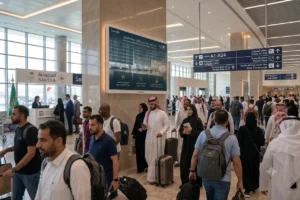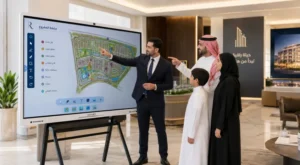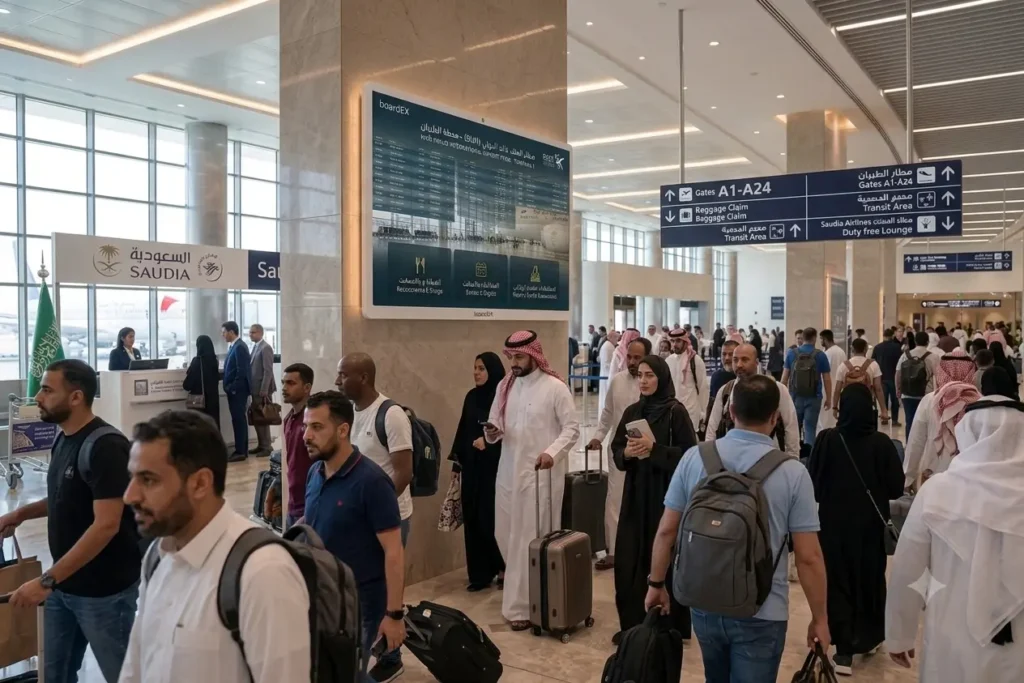
An interactive display for airports in Saudi Arabia is a large touchscreen that lets travelers find their way, check live flight or train information, and complete simple self-service tasks without waiting for a staff member. Inside a terminal or metro station, these panels take on three main jobs: wayfinding, live information, and self-service touch points, all in Arabic and English. As the Kingdom opens new airports and expands the Riyadh and Jeddah metro networks, transport operators are using these screens to move large volumes of passengers through busy concourses with less confusion and shorter queues.
Table of Contents
What interactive displays do in an airport or transport hub
A passive information screen only shows a fixed message. An interactive display responds to touch, so a traveler can search, zoom, tap through options, and pull up exactly the information they need. In a transport setting, that difference matters because every passenger arrives with a slightly different question.
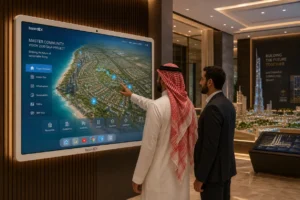
Across an airport or transit hub, the panels handle three core tasks. Wayfinding helps a passenger locate a gate, platform, exit, prayer room, or baggage belt from wherever they are standing. Live information shows real-time flight status, train times, and gate or platform changes pulled from the operator’s systems. Self-service lets travelers complete small tasks on their own, such as looking up a booking, finding a connection, or leaving feedback, which keeps staff free for the cases that truly need a person.
Where interactive touch points sit in a Saudi terminal
The value of these screens comes from placing them at the exact points where passengers slow down or hesitate. Rather than treating an airport as one space, it helps to map the panels to the zones a traveler passes through.
- Arrivals hall: orientation maps and ground-transport guidance for passengers who have just landed and need to reach taxis, ride-hailing, car parks, or the metro link.
- Check-in and departures: live flight boards and gate directions that update the moment a change is published, reducing crowding around a single central screen.
- Gate lounges: localized information near seating so waiting passengers can check status without walking back to a main display.
- Baggage reclaim: belt-assignment lookups and onward-travel details while travelers wait for luggage.
- Metro concourse and interchange: platform finders and line maps at the points where rail passengers transfer between lines or move between the station and the terminal.
Mapping screens to zones this way avoids a common mistake, which is installing a handful of displays in a lobby and expecting them to serve a whole building. Coverage at each decision point is what actually cuts wrong turns and staff interruptions.
Bilingual Arabic-first wayfinding for pilgrim and traveler traffic
Saudi transport hubs serve a mix of domestic travelers, business visitors, and very large seasonal flows of Hajj and Umrah pilgrims arriving from dozens of countries. A screen that handles Arabic and English cleanly, with a fast toggle and correct right-to-left layout, is not a nice extra here; it is the difference between a passenger self-serving and a passenger queuing for help.
This is where an Arabic-first interface earns its place. boardEX panels are built with a native Arabic interface and are backed by local installation and after-sales support across the Kingdom, which matters for public-sector transport buyers who need the display, the language layout, and the on-site service to come from one accountable supplier rather than a shipped-in product with no local team behind it.
Durability and uptime in high-traffic public environments
An airport display cannot behave like an office screen that rests overnight. It runs continuously, sits under bright concourse lighting, and is touched by thousands of hands a day. Three specifications decide whether a panel survives that duty cycle: continuous operation without overheating or image retention, an anti-glare surface that stays readable in daylight-heavy halls, and a cleanable front glass that holds up to frequent wiping in a shared public space.
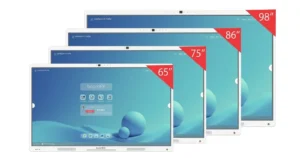
Reliability also depends on how the screen connects to the operator’s network, since live flight and train data have to arrive without lag or dropouts. The commercial-grade build and connectivity of a purpose-made interactive flat panel display is what separates a unit that runs for years in a terminal from a consumer screen that fails within months of round-the-clock use.
Self-service touch points that cut queue pressure
Every task a passenger completes on a screen is a task that does not become a line at a desk. Information kiosks answer the repeated questions, such as where a gate is or which platform a train departs from. Booking and connection lookups let travelers confirm their own onward journey. Simple feedback capture gives operators a live read on how a terminal is performing without a printed survey.
The passenger-facing panel is only half of it. Staff moving through a concourse can carry a mobile device that mirrors the same information and lets them assist travelers on the spot, which is where the smart tablet series pairs naturally with the fixed displays. Together, they let an operator scale help across a large hub without stationing a person at every corner.
Why boardEX for transport-sector deployments
boardEX is a Saudi interactive display brand and a flagship unit of BNB Group, operating since 2006 with offices in Riyadh, Jeddah, Dammam, and Khamis Mushayt. For a transport project that spans a full terminal or a metro line, that footprint means installation, training, and after-sales support are delivered by a local team rather than coordinated from abroad. The panels ship with a native Arabic interface and an AI-assisted feature set, and every deployment is scoped from a site survey through to ongoing maintenance, so an operator is buying a supported system rather than a box of screens.
Planning displays for a terminal, station, or transport project in the Kingdom? Talk to a boardEX advisor for a site survey and a tailored recommendation.
Frequently Asked Questions
Can interactive displays show live flight or train information?
Yes. The panels connect to an operator’s information systems over the network and update flight status, gate assignments, and train times in real time, so a change published centrally appears on every relevant screen at once.
Do the screens support Arabic and English at the same time?
They do. The interface is built Arabic-first with correct right-to-left layout and a fast language toggle, which suits the mixed domestic, business, and pilgrim traffic that Saudi transport hubs handle.
Are these panels built for 24/7 public use?
Yes. Transport-grade displays are rated for continuous operation and use an anti-glare surface that stays readable under bright concourse lighting, unlike consumer screens that are designed for intermittent home or office use.
How are airport touch screens kept clean and hygienic?
The front glass is designed to be wiped down frequently with standard cleaning agents, which lets facilities teams maintain hygiene on a high-touch surface that thousands of passengers use each day.
Can boardEX integrate displays with existing airport information systems?
Integration is scoped during the site survey. boardEX works with the operator’s IT team to connect the panels to existing flight, rail, and content-management systems, and supports installation, training, and after-sales locally.