Quick answer: Choose a wall mount when the panel will stay in one room and the wall can safely carry its weight. Choose a mobile trolley when one panel needs to serve several rooms, when the wall is glass, drywall or not yours to drill, or when the room layout changes often. Many Saudi schools end up with both: wall mounts in standard classrooms and a few trolleys for shared spaces.
The right choice depends less on the panel and more on the room. Below we explain how each option works in practice, where each one fits, and what to check before you order.
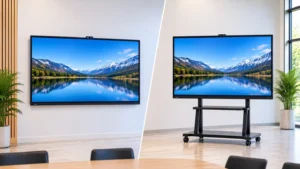
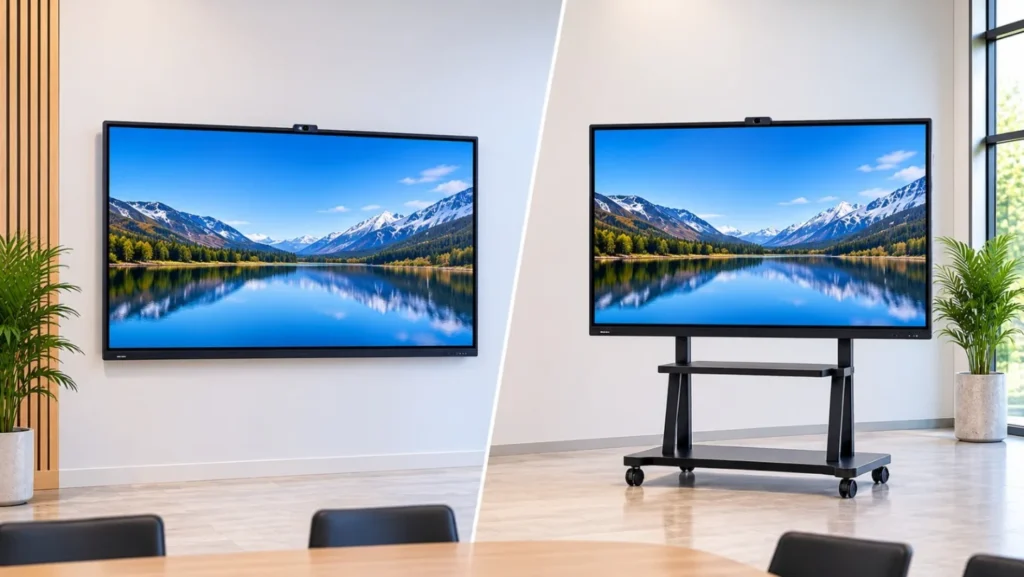
A wall mount fixes the panel to the wall with a bracket. Once it is installed, the panel is always in the same place, at the same height, with cables hidden and nothing on the floor. It is the most stable setup and takes up no floor space. The trade off is that the panel cannot move, and the wall must be strong enough to hold it.
A mobile trolley is a floor stand on wheels. The panel can be rolled to another part of the room or to another room altogether. Many trolleys also let you adjust height and tilt. The trade-offs are floor space, the need to lock the wheels every time, and a power cable that has to reach a socket wherever the panel goes.
Neither is better in general. Each one solves a different problem.
When a wall mount is the better choice
A wall mount makes sense when:
- The room is a fixed classroom. The same teacher and class use it every day, and the board is always at the front.
- The wall is solid. Concrete or block walls are usually suitable. Drywall or partition walls may need extra fixing or a floor supported bracket.
- Floor space is tight. A trolley base takes up room near the front, where students often sit closest.
- You want a tidy, permanent install. Cables can be hidden inside a plastic cable cover on the wall, running to a fixed power point, and there is nothing for students to knock or move.
- Younger students use the room. A fixed panel cannot be pushed or tipped, and its height can be set for the age group from day one.
Before choosing a wall mount, ask your installer to confirm the wall type, the panel weight, and that the bracket is rated above that weight. Plan the power point and cable route at the same time, so you do not end up with loose cables across the wall.
When a mobile trolley is the better choice
A trolley makes sense when:
- One panel serves several rooms. For example, a lab, library, or activity room that only needs a panel on certain days.
- The wall cannot be drilled. Glass walls, thin partitions, rented buildings or rooms due for renovation.
- The room layout changes. Training rooms, multipurpose halls and meeting rooms where furniture moves around.
- Different users need different heights. A height-adjustable trolley lets a primary teacher lower the panel, and a secondary teacher raise it.
- You need a panel quickly. A trolley can be in use as soon as it is delivered, with no wall work or drilling.
Before choosing a trolley, check door widths and any steps or lifts on the route between rooms. Large panels on trolleys are wide and heavy, so measure the panel and stand together against your doorways.
Which option fits which room?
This quick guide covers the rooms we are asked about most often.This quick guide covers the rooms we are asked about most often.
| Room type | Usually best | Why |
| Standard classroom | Wall mount | Daily use, fixed board position, saves floor space |
| Science or computer lab | Trolley | Shared use, panel can move closer to workstations |
| Library or activity room | Trolley | Occasional use, layout changes |
| Lecture hall | Wall mount | Fixed front position, often paired with a PTZ camera |
| Meeting room or boardroom | Wall mount | Permanent setup, clean look for visitors |
| Training room or multipurpose hall | Trolley | Flexible layouts and shared use |
| Rented or temporary building | Trolley | No drilling, easy to move when you relocate |
Treat this as a starting point. A classroom with a glass wall, for example, still needs a trolley.
Height and safety points for both options
Whichever you choose, agree the panel height with the teachers who will use it. In primary classes, students need to reach at least the lower half of the screen without stretching. In secondary classrooms and meeting rooms, the panel can sit higher so everyone can see it clearly from the back.
For wall mounts:
- Use a bracket rated above the panel’s weight and fixings suited to the wall type.
- Hide cables inside a cable cover on the wall and the power point close to the panel.
For trolleys:
- Lock the wheels before anyone writes on the panel.
- Move the panel with two people, slowly, and never while students are standing close by.
- Keep a power extension or socket plan for each room the trolley visits, so cables do not stretch across walkways.
Cost and long-term use Cost and long-term use
A wall mount is usually the simpler and lower-cost option per room, and many panel projects include a wall bracket as standard. A trolley is a separate purchase. However, a trolley can save money when it lets one panel serve two or three rooms that would otherwise each need their own.
Think about the next few years too. If your school might move, rearrange classrooms or expand, a trolley keeps your options open. If the rooms are settled, a wall mount is the cleaner long-term setup.
The boardEX interactive panel trolley stand
boardEX interactive flat panels come in four sizes: 65″, 75″, 86″ and 98″. The boardEX interactive panel trolley stand is built to carry all four, and it has:
- VESA support from 200 × 200 mm to 1000 × 600 mm.
- Height adjustment of up to 15 inches and a tilt mechanism.
- Four lockable 360° swivel casters and an anti-tip design.
- A heavy duty metal frame with built-in cable management.
- Load capacity of 100–150 kg.
- A 1-year warranty, with delivery from Riyadh in 1–2 weeks.
For more detail on choosing a stand, read our trolley stand buying guide, or see the full specifications on the interactive panel trolley stand page.
Not sure which setup suits your rooms? Our team can visit, check your walls and room layouts, and recommend the right mix of wall mounts and trolleys. Request a site assessment.
Frequently asked questions
Can I move a wall-mounted panel to a trolley later?
Usually yes, if the trolley supports the panel’s size, weight and VESA pattern. Check all three before ordering.
Is a trolley safe in a primary school classroom?
Yes, when the wheels are locked, the stand has an anti-tip design and only staff move it. For rooms with very young children, a wall mount is often the safer daily choice.
Can a drywall or partition wall hold an 86- or 98-inch panel?
Not always. Large panels are heavy, so ask your installer to check the wall first. Extra fixings, a floor supported bracket or a trolley are the usual alternatives.