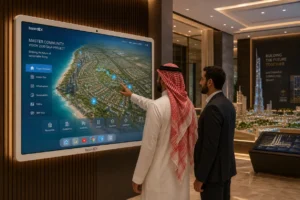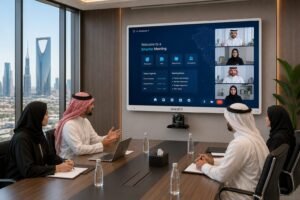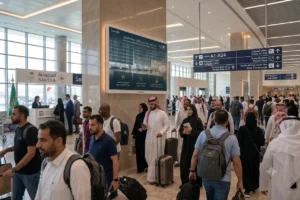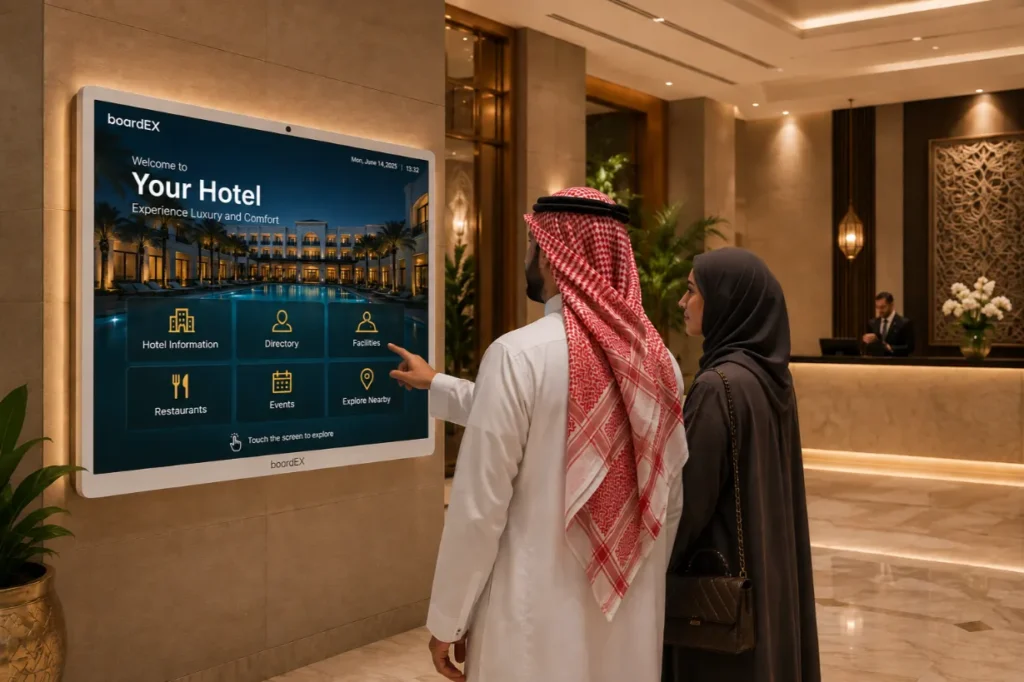
An interactive wayfinding display in a hotel is a large touchscreen, usually placed in the lobby or a busy public area, that lets guests find their room, locate facilities, read the day’s events, and get directions in their own language without waiting at the front desk. In Saudi hotels and resorts, where guests arrive as business travellers, tourists, and pilgrims who speak many different languages, a self-service screen that instantly switches between Arabic and English removes a lot of friction during the first few minutes of a stay. It shortens queues at reception, answers the questions guests most often ask, and gives a property a modern, guest-first feel from the moment someone walks in.
This guide looks at what interactive wayfinding does for a hotel guest, where the screens work hardest, and why the bilingual angle matters so much in the Saudi market.
Table of Contents
What guests actually use a wayfinding screen for
A wayfinding display earns its place by answering the small, repeated questions that otherwise land at the front desk. Guests walk up and, in a few taps, sort out the things that would each be a short queue on their own.
- Finding their way. An interactive floor map shows the route to the restaurant, the prayer room, the spa, the ballroom, or the parking, with the guest’s current position marked so the directions make sense.
- Seeing what is on. A live directory of the day’s conferences, weddings, and functions points each visitor to the right hall, which matters most on busy event days.
- Exploring hotel services. Restaurants, opening hours, the pool, the gym, and spa treatments are all in one place, so a guest can look through without asking.
- Getting local information. Nearby attractions, transport, and prayer times give tourists and pilgrims what they need without a trip to the desk.
None of this replaces good staff. It frees them. When the routine questions are handled at the screen, the front desk team can spend their time on the guests who actually need a person.
Where interactive displays work hardest in a hotel or resort
The value of a wayfinding screen depends heavily on where it sits. A few locations do most of the work.
The lobby
The lobby is where first impressions form and where the longest queues build at check-in and check-out. A touchscreen here catches guests in the exact moments they have a question, and a large, sharp panel reads as a deliberate design choice rather than a bolt-on. This is the single highest-value spot for a wayfinding display in most properties.
Event and conference floors
On a floor running several functions at once, guests get lost and arrive late. A directory screen at the lift lobby or the entrance to the event space shows which hall holds which function and points people the right way, which keeps an event running on time and takes pressure off the events team.
Resort grounds and large properties
A sprawling resort is hard to navigate on foot. A weatherproofed screen at a central point, or a set of them across the grounds, helps guests find the beach, the pools, the restaurants, and the activity desks across a site that a small printed map struggles to convey.
In the room, on a tablet
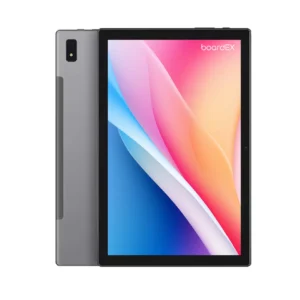
The guest directory does not have to live only on a wall. A compact in-room touchscreen can carry the same services, ordering, and information in the guest’s language, which is where a device from the smart tablet series extends the same self-service idea from the lobby to the bedside.
Why the bilingual angle matters so much here
Saudi hotels serve an unusually mixed set of guests. A single property might host domestic business travellers, international tourists arriving under the Kingdom’s tourism push, and, in Makkah and Madinah, large numbers of pilgrims who speak Arabic, English, Urdu, Malay, Turkish, and more, often within one week.
A printed sign or a single-language screen serves only some of them. An interactive display that switches between Arabic and English and can add further languages lets each guest read directions and services in a language they are comfortable with. For a property near the holy sites during peak pilgrimage seasons, an Arabic first interface with English and other languages a tap away is the difference between a lobby that flows and one that jams with confused arrivals.
The guest experience point: wayfinding is really about respect for the guest’s time and language. A screen that answers the first questions quickly, in a language the guest chooses, sets the tone for the whole stay.
What makes a good hotel wayfinding display
A screen that guests actually use, rather than walk past, comes down to a handful of qualities.
| What guests need | What the display should offer |
| To read it at a glance | A large 4K screen with clear, legible maps and menus |
| To use it in their language | An Arabic and English interface with more languages available |
| To find things without help | Simple, intuitive navigation anyone can follow on the first try |
| Current information | Content that updates in seconds when an event or service changes |
| A screen that lasts | Durable hardware built for constant public touch |
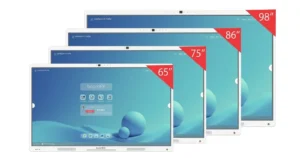
The same qualities that make a display good for a classroom or a boardroom, a sharp 4K screen, responsive touch, and a bilingual interface, carry over directly to a hotel lobby. boardEX builds these into its interactive flat panel displays, which a hotel can set up as a guest-facing wayfinding and directory screen rather than a presentation panel.
Getting started without disrupting guests
Adding wayfinding to a live hotel is mostly a question of planning. The screens go into public areas that stay open, so the work has to be quiet and scheduled around the property’s rhythm. boardEX surveys each location, recommends the right screen and placement for how guests move through the space, installs at times that avoid busy periods, and trains staff to update the content themselves, so a hotel team can run the displays day to day rather than depend on a supplier.
Thinking about wayfinding or guest directory screens for a hotel or resort? boardEX will survey your public spaces and recommend the right displays, installed and supported across Saudi Arabia.
Frequently asked questions
What is an interactive wayfinding display in a hotel?
It is a large touchscreen, usually in the lobby or a busy public area, that lets guests find their room, locate facilities, view the day’s events, and get directions on their own. It answers the questions guests most often bring to the front desk, which shortens queues and gives the property a modern, self-service feel.
Can a hotel wayfinding screen work in Arabic and English?
Yes. A good wayfinding display carries an Arabic and English interface and can add further languages, letting each guest read maps and services in a language they are comfortable with. This matters in Saudi hotels, which serve domestic, international, and pilgrim guests speaking many languages, often in the same week.
Where should a hotel place an interactive wayfinding display?
The lobby is usually the highest-value spot, since that is where guests form first impressions and where check-in queues build. Event and conference floors benefit from a directory screen near the lifts or hall entrances, and large resorts gain from durable screens placed at central points across the grounds.
Do wayfinding displays replace hotel front desk staff?
No. They handle the routine, repeated questions such as directions and opening hours, which frees the front desk team to spend time on guests who need real help. The aim is to support staff and shorten queues, not to remove the human side of hospitality.
How is guest information kept up to date on the screen?
Content on an interactive display updates in seconds, so event listings, service hours, and directions can be changed as often as needed, which a printed board cannot match. boardEX trains hotel staff to manage the content themselves, so a property can keep its screens current without calling the supplier.