As Saudi Arabia accelerates its Vision 2030 education agenda, a quiet but powerful shift is taking place inside classrooms across the Kingdom. PTZ camera hybrid learning in Saudi Arabia is no longer a niche consideration reserved for large universities. It has become a central pillar in how schools, colleges, and corporate training centres deliver education to students who are both physically present and learning from a distance.
This blog explores how PTZ cameras work, why they are particularly well-suited to the Saudi educational landscape, and what institutions should know before investing.
Table of Contents
What Is a PTZ Camera and Why Does It Matter for Hybrid Learning
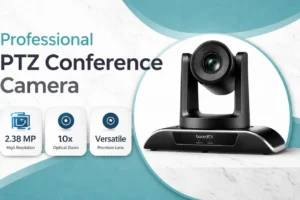
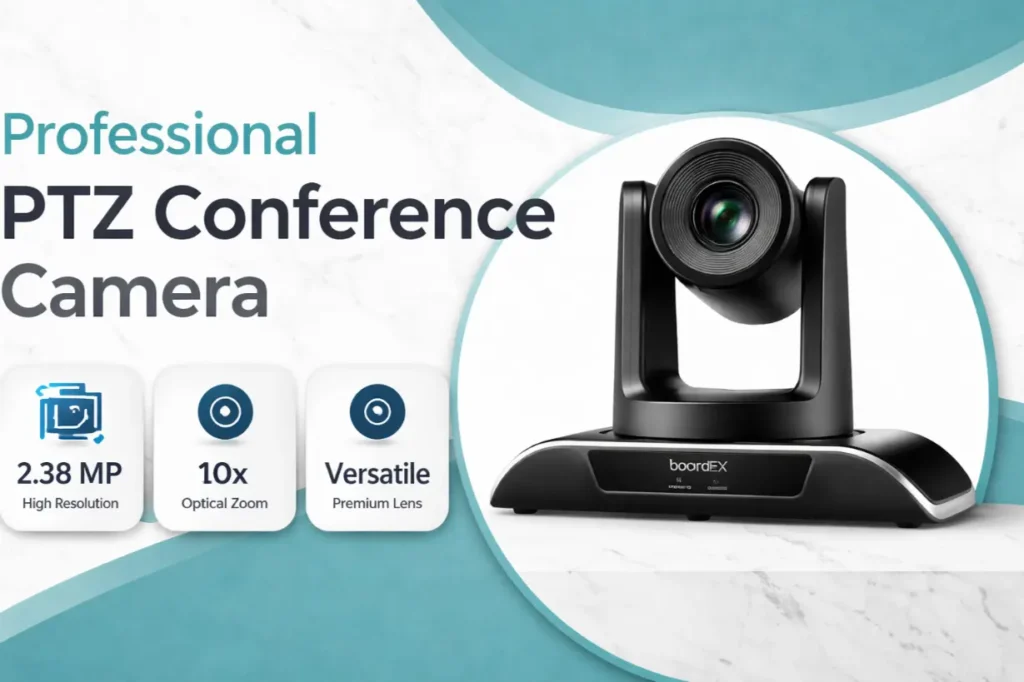
A PTZ camera is a type of motorised video camera that can Pan (move horizontally), Tilt (move vertically), and Zoom (bring subjects closer or push them wider), all of which can be controlled remotely or automatically. Unlike a standard fixed webcam, a PTZ camera can follow a moving instructor, capture student interactions, and deliver broadcast-quality video to remote participants in real time.
In a hybrid learning environment, the goal is to ensure that students who are attending online feel as engaged and included as those sitting in the room. A static camera fails at this because it cannot adapt to a dynamic classroom. A PTZ camera, on the other hand, is designed precisely for this kind of flexibility.
The Hybrid Learning Context in Saudi Arabia
Saudi Arabia’s education sector has undergone considerable transformation over the past several years. The COVID-19 pandemic accelerated the adoption of remote learning tools, and the Kingdom’s Vision 2030 framework has since formalised the role of digital education as a national priority. Institutions such as King Abdullah University of Science and Technology (KAUST), King Abdulaziz University, and a growing number of private schools are actively investing in smart classroom infrastructure.
Several factors make PTZ camera hybrid learning particularly relevant in the Saudi context.
Firstly, the country has a geographically dispersed student population. Many learners in rural or semi-urban areas benefit enormously from being able to access high-quality instruction remotely. Secondly, Saudi institutions are under increasing pressure to meet international academic standards, and the quality of recorded and streamed lectures is increasingly seen as a reflection of institutional quality. Thirdly, corporate learning and development departments within Saudi entities, particularly in the energy, healthcare, and finance sectors, are rapidly building hybrid training facilities.
Key Features of PTZ Cameras That Support Hybrid Education
When a PTZ camera is deployed in a classroom or lecture hall, several of its features directly address the challenges that educators and institutions face.
Auto-tracking technology is perhaps the most transformative feature. Through AI-powered motion detection, a PTZ camera is able to identify and follow the instructor as they move around the room. This means the camera operator is removed from the equation entirely, and the remote learner always has a clear, focused view of the teacher without any manual intervention being required.
Preset positioning allows the camera to be programmed to return to specific angles at the press of a button. For example, one preset might focus on the whiteboard, another on the instructor at the podium, and a third on the student seating area. This makes transitions between different parts of a lesson smooth and professional.
Remote control via software means that a coordinator sitting outside the room, or even in a different building, can manage the camera feed without disrupting the session. Many institutions in Saudi Arabia are now training a small number of dedicated AV technicians to manage multiple rooms simultaneously from a centralised control point.
High-definition output ensures that every slide, diagram, and facial expression is captured with clarity. For medical faculties, engineering departments, and technical training programmes, this level of visual fidelity is not a luxury but a requirement.
A Comparison of PTZ Camera Formats Used in Saudi Institutions
The following table outlines the most commonly deployed PTZ camera types across Saudi educational settings, along with their primary use cases.
| Camera Type | Resolution | Zoom Range | Best Suited For |
|---|---|---|---|
| Desktop PTZ | 1080p | 5x to 10x optical | Small seminar rooms, offices |
| Mid-range PTZ | 4K | 12x to 20x optical | Standard lecture halls |
| Ceiling-mount PTZ | 1080p to 4K | 10x optical | Large auditoriums, theatres |
| PTZ with AI tracking | 4K | 12x optical + digital | Hybrid classrooms, studios |
| Outdoor PTZ | 1080p | 30x optical | Campus-wide event coverage |
Institutions in Saudi Arabia are predominantly investing in mid-range and AI-tracking PTZ cameras for their hybrid classrooms, as these offer the best balance between performance and cost efficiency.
How PTZ Cameras Integrate With Learning Management Systems
One of the most important developments in recent years is the ability of PTZ cameras to integrate directly with Learning Management Systems (LMS) such as Blackboard, Moodle, and Microsoft Teams, all of which are widely used across Saudi universities and schools.
Through this integration, lectures that are captured via a PTZ camera can be automatically uploaded to the LMS as recorded sessions. Students who missed a live class are therefore able to revisit the content at a time that suits them. Furthermore, when PTZ cameras are paired with lecture capture software such as Panopto or Kaltura, the recording is often automatically synchronised with the presentation slides, producing a polished, indexed resource that students can navigate with ease.
This combination of live streaming and asynchronous access is particularly valuable in Saudi Arabia, where students frequently cite scheduling conflicts and commute distances as barriers to consistent in-person attendance.
The Role of PTZ Cameras in Supporting Vision 2030 Education Goals
Saudi Arabia’s Vision 2030 places significant emphasis on improving educational outcomes, increasing digital literacy, and preparing a skilled national workforce. Within this framework, the Ministry of Education has been actively promoting smart classroom adoption as part of the National Transformation Programme.
PTZ cameras contribute to these goals in a number of direct ways.
To begin with, they enable institutions to reach more students without requiring the construction of additional physical facilities. A single well-equipped lecture hall can serve hundreds of remote students simultaneously, which is an efficient use of both infrastructure and faculty time.
Additionally, high-quality recordings create a library of educational content that can be reused across academic years. This supports a shift towards more structured and scalable teaching models, which align with the Kingdom’s desire to benchmark its education system against global standards.
Furthermore, corporate training programmes operated by Saudi Aramco, SABIC, and various government entities have adopted hybrid PTZ setups to deliver consistent training across multiple regions of the country. The ability to train employees in Riyadh, Jeddah, Dammam, and Abha through a single live session represents a meaningful operational efficiency.
Challenges to Consider Before Deploying PTZ Cameras in Saudi Classrooms
While the benefits are considerable, there are several practical challenges that institutions must address before deployment.
Network infrastructure is the most common obstacle. A PTZ camera streaming 4K video requires a stable and sufficiently fast network connection. Many older school buildings in Saudi Arabia have not yet been upgraded to support this level of bandwidth, which means infrastructure investment is often a prerequisite.
Faculty training is another area that requires attention. Even the most sophisticated PTZ camera is of limited value if the instructor does not know how to position themselves for optimal tracking, how to manage the presenter view during a hybrid session, or how to ensure that remote students can contribute to classroom discussions.
Privacy and data considerations must also be managed carefully. In Saudi Arabia, as in most jurisdictions, policies around the recording and storage of educational content involving students and faculty are subject to institutional and national guidelines. These must be reviewed and communicated clearly before any recording infrastructure is activated.
The cost of integration can be higher than anticipated when audio systems, software licences, and AV infrastructure are taken into account. PTZ cameras function best as part of a comprehensive hybrid classroom solution, not as standalone devices.
Best Practices for PTZ Camera Deployment in Saudi Educational Settings
Institutions that have successfully integrated PTZ cameras into their hybrid learning programmes tend to follow a consistent set of practices.
Firstly, a pilot phase is carried out in one or two rooms before wider rollout. This allows technical teams to identify integration issues and educators to develop confidence with the technology before it is scaled.
Secondly, acoustic treatment of the room is addressed alongside the camera installation. Remote learners are often more sensitive to poor audio than to imperfect video, so microphone placement and room acoustics are treated as equally important.
Thirdly, student orientation is provided at the start of each term. Remote students are shown how to access live streams, how to raise questions during a session, and how to navigate recorded content. This simple step has been shown to significantly improve engagement rates in hybrid cohorts.
Fourthly, institutions are encouraged to review camera placement in relation to cultural norms. In some Saudi educational environments, camera angles and recording policies need to be adapted to reflect institutional or community expectations around privacy and gender-separated learning spaces.
PTZ Cameras and the Future of Saudi EdTech
Looking ahead, the trajectory for PTZ camera hybrid learning in Saudi Arabia is one of continued growth. Several developments are expected to shape the next phase of adoption.
AI-driven analytics are increasingly being embedded into PTZ camera systems. These tools are capable of measuring student engagement by analysing attention patterns, participation frequency, and even seating distribution in the classroom. For Saudi institutions focused on improving learning outcomes, this kind of data has significant value.
Frequently Asked Questions – PTZ Cameras Are Transforming Hybrid Learning in Saudi Arabia
What is the main advantage of a PTZ camera?
A PTZ camera can pan, tilt, and zoom to cover a large area on its own. One PTZ camera can do the job of several fixed cameras, saving money and space.
How do PTZ cameras work?
PTZ cameras have motors that move the lens left, right, up, down, and zoom in or out. They can be controlled manually or set to track movement automatically. Most connect via the internet and can be programmed to check specific spots on a schedule.
What is the Saudi Vision 2030 education program?
It is a plan by Saudi Arabia to improve its education system by 2030. The goal is to focus more on technology, science, and skills training so young Saudis are ready for modern jobs and the country relies less on oil income.
What are the disadvantages of PTZ cameras?
PTZ cameras can only look in one direction at a time, so they can miss things while turning. They cost more than regular cameras, have moving parts that can break, and need proper setup to work well.
Ready to Upgrade Your Classroom?
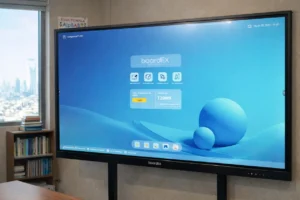
If your institution is exploring a hybrid learning infrastructure in Saudi Arabia, BoardEX can help. From Interactive Flat Panels to the PTZ Camera Vision Pro, their team offers end-to-end support, including installation, training, and ongoing technical assistance across Riyadh, Jeddah, Dammam, and Khamis Mushayth.