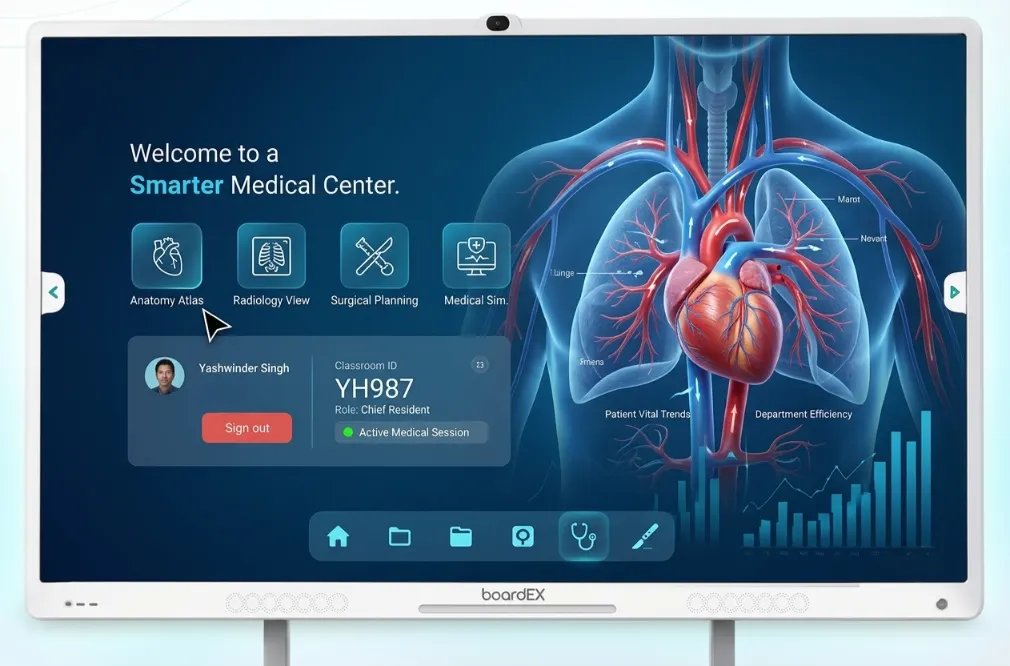
An interactive flat panel for medical training is a large 4K touchscreen that turns lectures, ward rounds, and case discussions into hands-on clinical sessions. In Saudi hospitals, it is used to run multidisciplinary tumour boards, review imaging side by side, simulate patient encounters for residents, and connect remote specialists into the room. The value is simple: trainees stop watching slides and start working through real cases together on one shared screen.
Most articles about interactive displays in healthcare stop at “hospitals use smart screens for signage and telemedicine.” That is true, but it misses where the real teaching value sits. This guide goes deeper into how a clinical educator, a residency program director, or a hospital IT lead actually puts a panel to work, and why it matters for institutions training the next generation of Saudi physicians under the Health Sector Transformation Program.
Table of Contents
Why hospitals are moving teaching off the projector
Medical education has a specific problem that ordinary classroom tech does not solve. A resident does not learn oncology by reading a slide. They learn it by arguing through a case with a surgeon, a radiologist, and a pathologist in the room, each pulling up their own evidence. The teaching tool has to hold all of that at once, remain legible from the back of a packed seminar room, and allow several people to annotate the same image without anyone leaving their seat.
Projectors fail this on three counts. They wash out under the bright lighting of a hospital teaching room; they offer no touch interaction, and they force one person to drive while everyone else watches. A high-touch-point interactive panel removes all three limits. Up to forty touch points mean a consultant and two residents can mark up the same scan together, and 4K clarity keeps fine detail readable whether the content is a histology slide or a contrast-enhanced CT.
This shift matters more in Saudi Arabia than in most markets. The Saudi Commission for Health Specialties runs a large and growing slate of Saudi Board residency and diploma programs, and teaching hospitals across Riyadh, Jeddah, and the Eastern Province are expanding their training capacity. Better teaching infrastructure is no longer optional for institutions competing to attract and retain residents.
Eight ways an interactive panel is used inside a hospital
The use cases below are grouped by department and function rather than by hospital name because the same panel serves very different rooms within a single facility.
1. Multidisciplinary team meetings and tumour boards
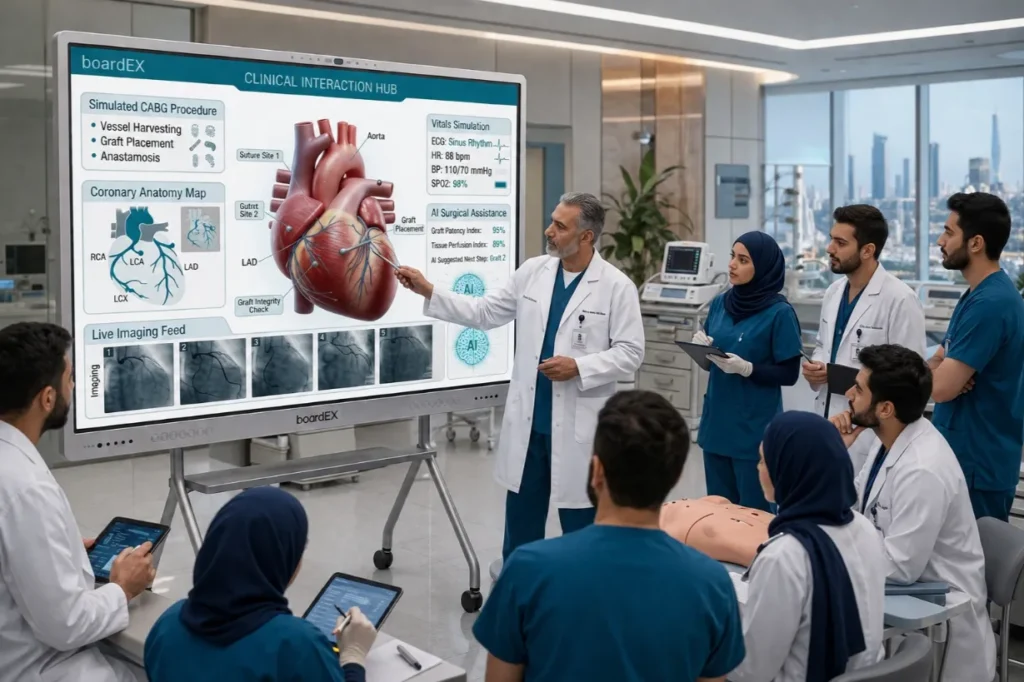
The tumour board is the clearest example of why touch and clarity matter. Oncology decisions are made by a group: medical oncology, surgery, radiation oncology, pathology, and radiology, each presenting its view of one patient. On an interactive panel, imaging, histology, and the treatment timeline sit on screen together, and any specialist can annotate directly. Research on tumour-board simulation in medical education found that trainees rated these sessions as essential for learning clinical reasoning, yet they remain underused in formal teaching. A shared interactive surface is what makes running them as a regular teaching format practical.
2. Resident clinical reasoning and case-based learning
Case-based learning works best when the case unfolds live. An educator can reveal history, then labs, then imaging step by step, pausing for residents to commit to a differential before the next clue appears. The endless-canvas and split-screen tools let the group hold the working diagnosis on one side while building the evidence on the other. Notes from the session save automatically, so the worked case becomes a revision asset rather than a chalkboard that gets wiped.
3. Grand rounds and CME sessions
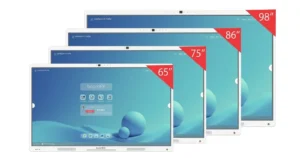
Grand rounds bring a whole department together, often with junior staff standing at the back. A large 86-inch panel keeps slides, ECGs, and imaging sharp across the room, and wireless casting lets a visiting speaker present from their own laptop or phone without cable handovers. The sizing and sightline maths here are the same problem a university faces in a tiered lecture theatre, which is why the configuration mirrors what boardEX recommends for university lecture halls in Saudi Arabia.
4. Imaging review and PACS integration
Radiology and surgical planning depend on imaging that holds up at scale. A 4K interactive display renders DICOM images from a PACS workstation with the detail clinicians need, and the touch layer lets a radiologist measure, zoom, and mark a lesion while teaching. This is not a diagnostic-grade reading monitor and should not replace one, but for teaching, planning huddles, and multidisciplinary review, it provides the whole room with a clear, shared view.
5. Simulation and skills-lab debriefs
Simulation centres record scenarios on mannequins, then debrief the team afterward. The panel becomes the debrief surface: the recorded encounter plays back, the facilitator scrubs to key moments, and the team annotates what they would change. Telemedicine simulation, where trainees practise remote consultation and handover, runs on the same screen with the built-in camera and microphone handling the remote link.
6. Telemedicine and remote specialist consults
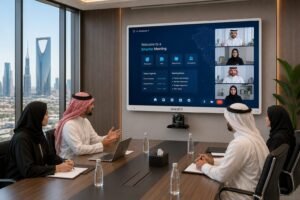
Saudi Arabia’s investment in connected healthcare means a district hospital often needs a specialist who sits in a tertiary centre hundreds of kilometres away. An interactive panel with integrated conferencing turns a consult room into a virtual bedside: the remote specialist sees the imaging, annotates it live, and the local team sees the marks appear in real time. The conferencing demands here are identical to those of a hybrid boardroom, so a consult room can be specified from the same playbook boardEX uses for corporate meeting rooms in Saudi Arabia. The same setup supports tele-ICU oversight and remote second opinions.
7. Nursing education and in-service training
Nursing in-service training covers protocols, new equipment, and infection-control updates on a rolling basis across shifts. A wheeled panel on a trolley stand moves between units, so the same session reaches the day and night teams in their own ward. Multi-language support matters here, since clinical teams in the Kingdom often work across Arabic, English, and other languages.
8. Patient-flow, briefings, and command rooms
Outside teaching, the same display class drives bed-management dashboards, daily safety briefings, and emergency command rooms where live data and floor plans need to stay visible to a standing team. One product family covering teaching rooms, consult rooms, and operations rooms simplifies procurement and support for the hospital’s technical team.
| Hospital space | Typical screen size | What is it used for | Key feature that matters |
| Seminar / case-discussion room | 75-inch | Resident teaching, MDT prep | Multi-touch annotation, autosave |
| Auditorium / grand rounds | 86-inch | CME, department meetings | 4K clarity at a distance, wireless casting |
| Tumour board room | 86-inch | Interdisciplinary cancer review | Split-screen, high touch-point count |
| Simulation/skills lab | 75-inch | Scenario debrief, tele-sim | Recording, camera, microphone |
| Consult / telemedicine room | 65-inch | Remote specialist consults | Integrated conferencing |
| Mobile in-service training | 65-inch to 75-inch on stand | Nursing and ward updates | Trolley mobility, multi-language |
How interactive panels help train medical students and residents
The strongest argument for these displays is not the hardware. It is what active, shared interaction does to clinical learning. Three mechanisms drive the benefit.
It makes thinking visible. When a resident has to walk to the screen, mark the artery they are worried about, and defend the choice, the educator sees the reasoning, not just the answer. That is the whole point of clinical-reasoning training, and a passive slide deck cannot produce it.
It supports interdisciplinary decision-making early. Studies on mock tumour boards for students show measurable gains in understanding how multidisciplinary teams reach a treatment plan. Giving students a real shared surface to run those mock boards on, rather than a one-way projector, is what lets a teaching hospital make the format routine.
It captures the session. Autosave and intelligent search mean a worked case, an annotated scan, or a debrief is retrievable later. A residency program builds a library of taught cases over a year instead of erasing each one.
A worked example: running a mock tumour board
A program director loads an anonymised case onto the panel. Four residents take the roles of medical oncologist, surgeon, radiation oncologist, and pathologist. Each pulls their evidence onto a split section of the screen and annotates it. A fifth resident, acting as the treating physician, summarises the board’s recommendation and explains it to a sixth, playing the patient. The whole exchange is saved automatically and becomes teaching material for the next cohort. None of this works smoothly on a projector because everyone needs to touch the same surface at once.
Buying considerations specific to healthcare
Hospital procurement asks questions a classroom never does. There are three things worth planning for before a demo.
Hygiene and surface cleaning. Teaching rooms near clinical areas need surfaces that tolerate routine wipe-down with approved cleaning agents. Specify a sealed glass front and confirm the manufacturer’s cleaning guidance during evaluation, rather than assuming a consumer screen will cope.
Integration with existing clinical systems. The panel should display from a PACS workstation, a hospital laptop, and a conferencing platform without a rebuild of the room. Before a demo, it helps to check the input options and wireless casting on the boardEX interactive flat panel display against what the department already runs, so nothing is discovered on installation day.
Centralised management for multi-site groups. Hospital networks running several sites benefit from a device management system that lets the technical team monitor, update, and control every panel from one dashboard, so a unit in Dammam and a unit in Riyadh stay on the same configuration.
boardEX supports hospitals and medical training centres across the Kingdom with site survey, installation, staff training, and after-sales support from four physical offices in Riyadh, Jeddah, Dammam, and Khamis Mushayt. Where a teaching room sits inside a wider clinical building, it usually shares a specification with the consult rooms and ward displays around it, and the way boardEX maps panels to each of those hospital spaces across Saudi Arabia follows the same room-by-room logic set out above.
Planning panels for a teaching hospital or training centre?
Book a free on-site demo and let the boardEX team configure the right setup for your seminar rooms, MDT room, and consult spaces. Request a free demo
Frequently asked questions
Can an interactive flat panel be used for reading diagnostic radiology?
No. A teaching panel is for review, planning, and education, not primary diagnosis. Diagnostic reading still needs a calibrated, regulatory-grade medical display. The panel is ideal for multidisciplinary review, teaching, and showing images to a whole room from a PACS workstation.
What screen size suits a hospital tumour board room?
An 86-inch panel is the common choice for tumour board and grand-rounds rooms, because several people need to read imaging and histology from a distance at once. Smaller seminar and consult rooms are usually served well by 75-inch or 65-inch panels.
Does the panel support remote specialists for telemedicine teaching?
Yes. With an integrated camera, microphone, and conferencing support, a remote specialist can join a consult or teaching session, view the imaging, and annotate it live while the local team sees the marks in real time.
Can the same panel move between wards for nursing in-service training?
Yes. Mounted on a wheeled trolley stand, a 65-inch or 75-inch panel can move between units so day and night teams receive the same session in their own ward, with multi-language support for mixed clinical teams.
How does boardEX support hospitals after installation?
boardEX provides site survey, installation, staff training, and ongoing after-sales support from four physical offices in Riyadh, Jeddah, Dammam, and Khamis Mushayt, with centralised device management available for multi-site hospital groups.