If you teach in Riyadh, Jeddah, or Dammam, you already know how much of the working week disappears into preparation. AI lesson planning is changing that. Built directly into modern interactive panels, it lets a teacher turn a topic and a year group into a structured, ready-to-teach lesson in a matter of minutes, without leaving the front of the classroom or opening a separate app.
This guide explains what AI lesson planning is, how it works on an interactive panel, and what it realistically means for Saudi schools in 2026.
Table of Contents
What is AI lesson planning?
AI lesson planning is the use of artificial intelligence to generate teaching material, lesson outlines, objectives, activities, worksheets, and assessment questions from a short prompt entered by the teacher. Instead of writing a plan from a blank page, the teacher enters the subject, topic, and class level, and the system produces a draft built around the curriculum.
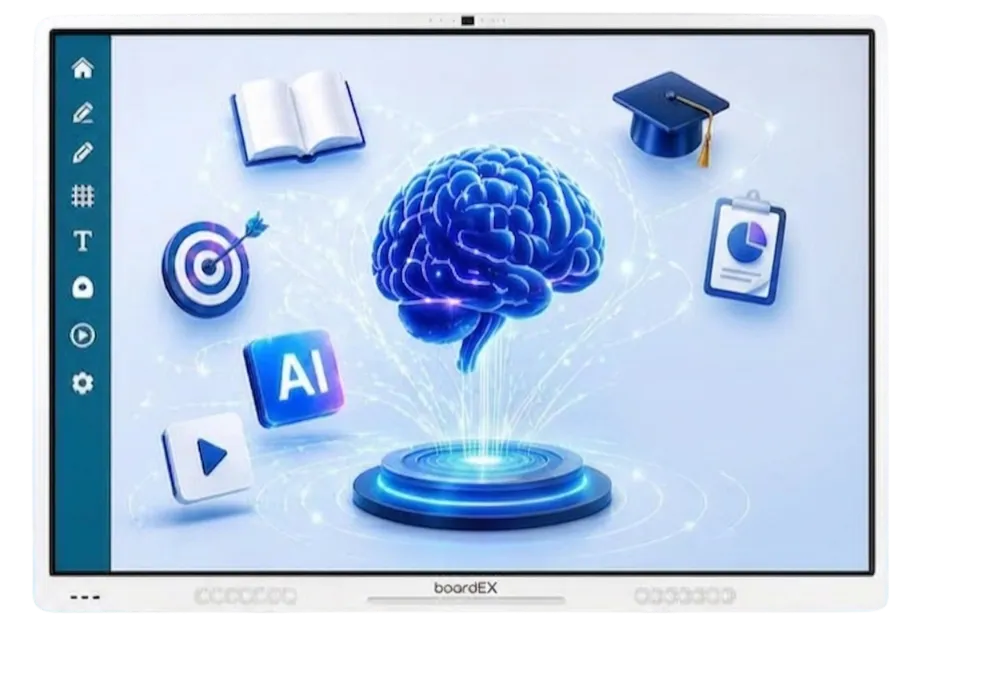
The important distinction in 2026 is where the AI sits. boardEX builds these planning tools directly into its interactive flat panel displays, so everything runs on the panel itself; there is no add-on subscription, no laptop, and no copying between devices. The teacher writes, edits, and presents in one place.
How does AI lesson planning work on an interactive panel?
The workflow is deliberately simple because the goal is to save time rather than create a new piece of software to learn. In practice, it looks like this:
- Enter the topic. The teacher types or speaks a topic, for example, “photosynthesis, Grade 7 science,” directly on the panel.
- Set the parameters. Class level, lesson length, and language (Arabic or English) are selected. The system uses these to scope the content rather than producing something generic.
- Generate the draft. The AI returns a structured plan: objectives, a starter activity, the main teaching sequence, and a closing task.
- Edit on screen. The teacher refines the draft, shortening a section, adding a local example, adjusting the difficulty, using touch or the on-screen keyboard.
- Teach from it. The finished plan is delivered straight from the panel, with linked resources, images, and questions available as the lesson runs.
Because the intelligent classroom technology is bilingual, the same process works in Arabic-medium, English-medium, and dual-language classrooms, including Arabic handwriting recognition, which matters for schools running bilingual programmes.
What can Saudi teachers actually create?
The value becomes clearer when you look at the individual tasks AI planning removes from the day:
- Full lesson plans aligned to the topic and year group, rather than a one-size-fits-all template.
- Differentiated activities for mixed-ability groups within the same class.
- Assessment questions and quizzes are generated from the lesson content, so the test matches what was actually taught.
- Starter and plenary tasks to open and close the lesson with structure.
- Resource suggestions — diagrams, worked examples, and prompts — pulled together in one view.
A plan that once took an evening can be drafted in minutes, leaving the teacher to do the part AI cannot: knowing the class, reading the room, and teaching well.
Why AI lesson planning matters for Saudi schools
Saudi Arabia’s Vision 2030 places education and a digitally literate generation at the centre of national transformation, and the Ministry of Education has encouraged schools to adopt technology that supports active, student-centred learning. AI lesson planning fits that direction precisely: it shifts teacher time away from administration and towards instruction.
For school leaders, there are practical benefits too. Consistent, well-structured plans are easier to share across departments, easier to review, and easier to demonstrate to inspection bodies and governors. For schools building digital capability gradually, on-panel planning is a low-friction starting point because it requires no extra infrastructure.
It is worth being realistic. AI classroom technology is still maturing across the Kingdom, and outcomes vary with the quality of teacher training and the level of institutional support. The schools seeing the strongest results are those that pair the tools with proper onboarding, not those that expect the panel to do the teaching.
How to start using AI lesson planning
For schools considering adoption, a measured approach works best:
- Identify the pain point. Is it planning time, assessment consistency, or engagement? That tells you where AI planning will pay back fastest.
- See it live. A short demonstration on a real panel is the most reliable way for teachers to judge whether the tools suit their subject and style.
- Train before you scale. Confident teachers use the features; uncertain teachers leave them switched off. Onboarding is the difference.
- Start with one classroom, measure the time saved, then expand on evidence rather than assumptions.
To arrange a demonstration in Riyadh, Jeddah, Dammam, or elsewhere in the Kingdom, contact boardEX or message the team on WhatsApp at +966 55 430 0901.
Frequently asked questions
Does AI lesson planning replace the teacher?
No. It automates the preparatory work, drafting plans, generating questions, and suggesting resources, so the teacher can spend more time on instruction and on individual students. The teacher reviews and adapts every plan and remains central to the lesson.
Can AI lesson planning work in Arabic?
Yes. On the boardEX panel, the planning tools are fully bilingual, supporting Arabic and English across content generation, including Arabic handwriting recognition. This suits Arabic-medium, English-medium, and dual-language schools.
Is AI lesson planning suitable for all year groups?
It is. Plans can be scoped by class level and subject, from primary through secondary and into higher education, with the depth and language adjusted to the group entered by the teacher.
Do we need extra software or a subscription to use it?
No separate software is required. The planning tools are built into the interactive panel and are available from the first day, with no additional installation.
How accurate are the lesson plans the AI produces?
They are drafts intended to be reviewed and edited, not final documents. The teacher refines each plan for accuracy, local relevance, and class needs before teaching from it, which is why teacher oversight remains essential.